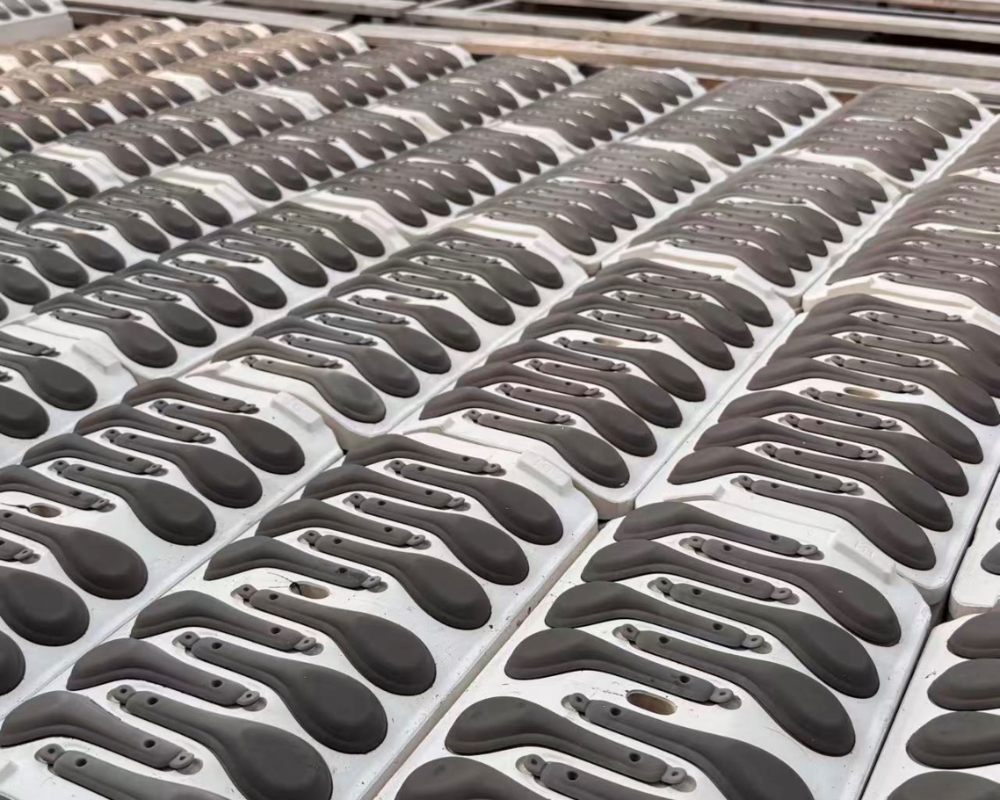
Every custom ceramic shape begins as a mould. A dinnerware plate, a mug handle or a teapot lid cannot be made to a customer's drawing without a plaster mould built from a master model, and that mould decides the finished size, the wall thickness and the surface the customer eventually approves. For buyers developing a private-label range, understanding the tooling stage is the difference between a smooth sampling process and months of unexplained size drift.
This guide explains how tooling works in ceramic tableware production, what the tooling cost actually covers, and what to send with your enquiry so the first-fired sample is close to the finished product.
1. What "tooling" means in ceramics
Unlike metal or plastic parts, ceramic tableware is not machined or injected. The process is: a master model defines the shape, a case mould is taken from it, working plaster moulds are produced from the case, and the product is then cast or jiggered in those plaster moulds, dried, glazed and fired. Each stage shrinks the part slightly, and each stage adds a step where the shape can go wrong.
2. Master model and case mould
The master model is the definitive version of the shape, usually turned or 3D-printed at an oversize scale to allow for shrinkage. It can be revised by hand until the proportions look right - the handle angle on a mug, the radius on a plate rim, the way a lid sits. Once the buyer approves the master model, a case mould (also called a block mould) is produced from it in plaster or resin. The case mould is the reference tool for the whole programme: every working mould made from it should produce the same shape.
3. Working moulds and mould life
Working moulds are the consumable tools used in daily production. A plaster working mould absorbs water from the slip or clay body and slowly loses its definition; a mould that has cast a few dozen pieces will produce a slightly different part than a new one. Typical practice is to retire a working mould after a set number of casts and to keep a sufficient stock of moulds on rotation so that production always runs on moulds in good condition. Two consequences for buyers:
- Mould consumption is part of the unit cost. Ask how many casts a plaster mould is expected to deliver for your shape and how often moulds are replaced, and make sure that running cost is included rather than charged later.
- Reorders should be made from the same case mould. If the case mould is lost or worn, the replacement shape may differ from the approved sample in ways that are visible in a mixed shipment.
4. Shrinkage: why your model is not the finished size
Ceramic bodies shrink during drying and firing, and total linear shrinkage is significant - dependent on body, water content and firing temperature, but commonly in the range that requires the master model to be made noticeably larger than the finished piece. This is why:
- Dimensions cannot simply be scaled from a finished sample to a drawing, or vice versa, without confirming the shrinkage factor for the specific body and process.
- Dimensional tolerances on fired ceramic are wider than on machined parts, and should be specified as realistic ranges rather than tight limits.
- Wall thickness, handle joints and fitted parts such as lids and strainers need to be designed around shrinkage, not corrected afterwards.
5. The sample stages
A ceramic sample is not one object but a sequence, and each stage answers a different question:
- Greenware (unfired) sample - confirms the shape, wall thickness and handle attachment before any firing cost is spent.
- Bisque sample - shows the body after first firing, with colour, porosity and defects visible.
- Glazed and decorated sample - the finished appearance, including glaze colour, decal position and any gold banding.
- Approved reference sample - the physical master against which production is measured, kept by both parties.
Sampling a new shape normally takes more than one round. The first round reveals geometry and shrinkage corrections, the second confirms colour and decoration, and a third is common where a fitted lid or handle needs adjustment.
6. What drives tooling cost
- Number of distinct shapes. A 20-piece dinnerware set may need a mould for every different item and size, and tooling is quoted per shape.
- Shape complexity. Handles, spouts, lids, relief patterns and non-round sections require multi-part moulds and more hand work.
- Relief and surface detail. Moulded decoration must be cut into the master model; fine detail is labour-intensive and can lower mould life.
- Size and wall thickness. Large platters and thin-walled pieces are harder to cast and dry without distortion.
- Number of sizes in a family. A plate range in four diameters means four tools, even though the design is the same.
7. What to send with your enquiry
- 3D model or technical drawing of each item, with the dimensions that matter to fit and stacking marked.
- Material and body preference (bone china, fine porcelain, stoneware, enamel) or the target price point if undecided.
- Decoration intent - plain, decal, hand-painted, gold banding, and whether the artwork exists.
- Volumes: first order, annual demand, and how the range might expand.
- Fitted parts: lids, strainers, handles, stacking and nesting requirements.
- Destination market and any food-safety certification the range must carry.
- Packaging direction: bulk, gift box or retail-ready.
Sourcing checklist
- Confirm tooling cost per shape, and whether it is charged once or amortised into the unit price.
- Ask who owns the master model, case mould and working moulds, and where they are stored.
- Request the expected mould life in casts and how it affects the unit price.
- Get the shrinkage factor and the dimensional tolerance band in writing before approving a master model.
- Approve a physical reference sample for every item in the range, not only for the hero piece.
- Agree the revision process: how a shape change is quoted, and how it is reflected in the reference sample.
Juxinmeng Ceramic develops custom shapes for ceramic tableware and tea ware ranges, from master model and mould making through sampling, glazing and decoration. Send us your drawings or reference samples and we will return a tooling and unit-cost proposal for your review.