
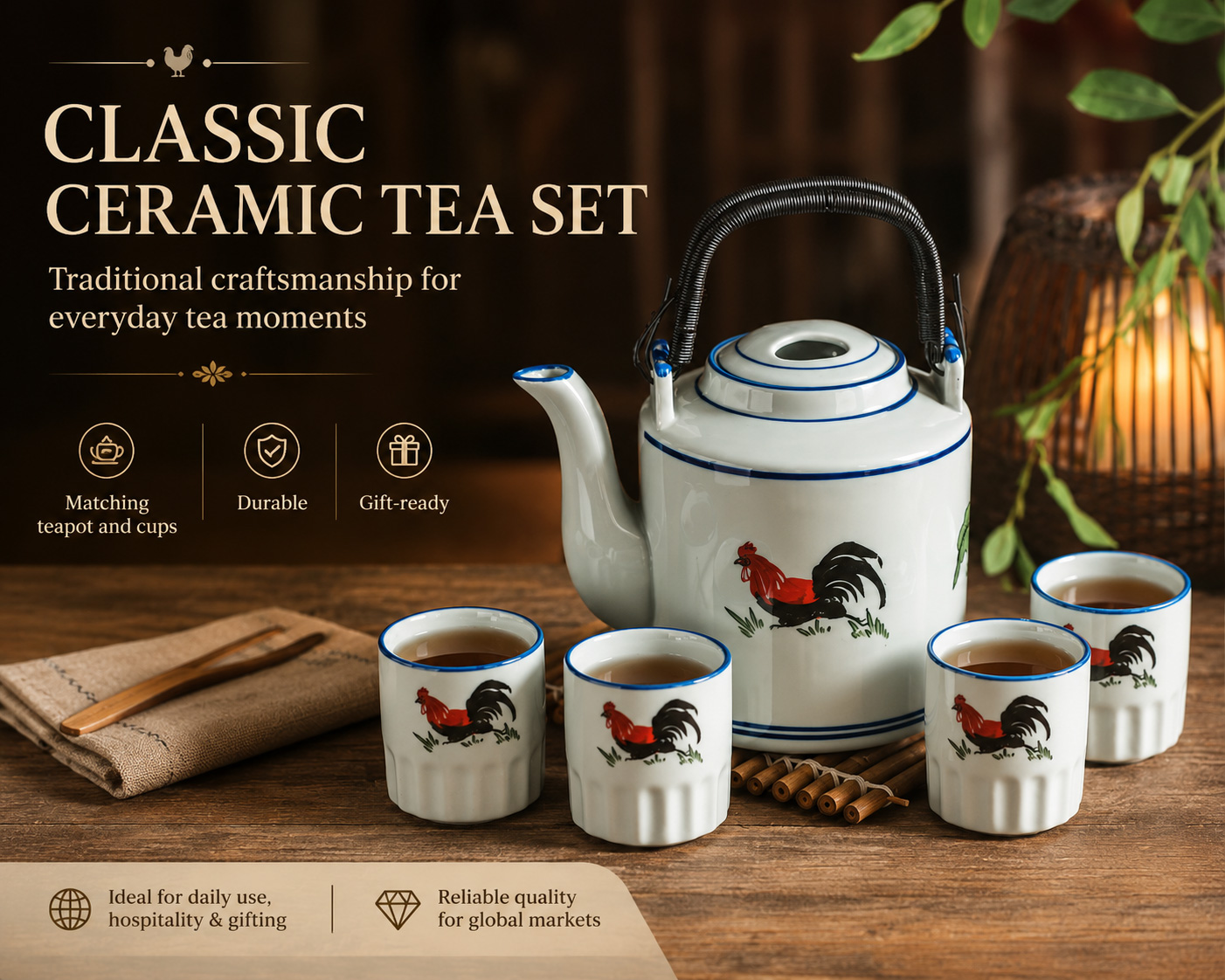
Quick answer: In 2026 the three bone china channels are pulling the product in different directions. Retail wants a complete, photogenic set at an accessible price, sold as a gift or an upgrade. Hospitality wants a durable, replaceable item with a stable specification that can be reordered for years. Gifting and corporate wants decoration and packaging that carry a story. A single bone china body can serve all three, but not with one specification. The set composition, the rim, the decoration and the pack all need to be decided per channel.
In this article
- Where bone china sits in the 2026 tableware market
- Retail: sets, photography and the gift occasion
- Hospitality: durability, replaceability and specification stability
- Gifting and corporate: decoration and packaging as the product
- Online marketplace effects on shape and decoration
- A channel specification matrix
- Range planning: how many SKUs does a channel really need
- What to watch through 2026
- Frequently asked questions
Where bone china sits in the 2026 tableware market
Bone china occupies a specific and durable position. It is the most translucent and the lightest of the common tableware bodies, with a warm ivory-white tone rather than the cool blue-white of fine porcelain. That combination — translucency, warmth, a thin rim that feels refined in the hand — is what buyers pay a premium for, and it is the reason the category has not been displaced by cheaper bodies.
But the premium is not automatic. In 2026 the buyer of bone china is choosing it for a reason, and that reason differs sharply by channel. Understanding those reasons is the difference between a range that sells and a range that sits in a warehouse waiting for a markdown.
| Channel | Primary motivation to buy | Sensitivity | What makes it fail |
|---|---|---|---|
| Retail (store and online) | Gift occasion, home upgrade, set completeness | Price point and visual appeal | Incomplete set; dull photography; a rim that chips in the first weeks |
| Hospitality and food service | Rim feel at the table, brand presentation, replaceability | Durability and total cost of ownership | Specification change between reorders; breakage rate above plan |
| Gifting and corporate | Presentation, personalisation, unboxing | Decoration and packaging quality | Decoration that looks cheap; packaging that arrives damaged |
| Promotional and incentive | Perceived value at a target cost | Unit cost | Damage in transit; a value story that is not visible |
Retail: sets, photography and the gift occasion
The retail channel buys bone china as an occasion product. The dominant occasions are weddings, housewarmings, anniversaries and the December gift window, with a secondary driver in the home-upgrade purchase where a shopper replaces a mixed everyday set with something more considered.
Set composition is the primary purchase decision
Retail buyers rarely evaluate a single plate. They evaluate a set, and the composition of that set is a merchandising decision as much as a product one. Three structures recur:
- The dinner service. Place settings for a stated number, plus serving pieces. The value story is completeness — the ability to serve a full meal.
- The tea or coffee set. A focused configuration of cups, saucers and a pot or server. Higher perceived gift suitability, smaller pack, lower entry price.
- The curated bundle. A small number of items chosen for visual variety rather than function — a cake stand, a mug, a small dish — positioned as a gift rather than as a service.
The recurring failure in retail is an incomplete set. A dinner service that omits a serving platter, or a tea set with no pot, forces the shopper to complete the purchase elsewhere and often loses the sale entirely. Set completeness should be derived from the actual meal or ritual the customer imagines, not from a convenient carton quantity.
Photography is a specification, not a marketing task
Bone china's best selling point — translucency — cannot be shown in a flat, evenly lit pack shot. Retail buyers increasingly specify imagery that shows the ware backlit or with a light source behind the rim, so the glow is visible. This has a practical consequence for the supplier: a factory that cannot produce consistent, high-quality white-background and lifestyle product imagery is a liability in this channel, regardless of ceramic quality.
If you are a retail buyer writing a brief: specify the imagery deliverables in the same document as the product specification. Backlit translucency shot, group shot of the full set, single-item close-up of the rim and foot, and a pack shot. Ordering these after production is how launches slip.
Hospitality: durability, replaceability and specification stability
Hospitality buys functionally and repurchases repeatedly. The decision criteria are different enough from retail that the same product cannot be specified unchanged.
The rim is the specification
In food service, the rim of a plate or bowl takes the wear: stacking, bussing, dishwasher racks. A thin decorative rim that looks elegant in a retail photograph can have an unacceptable breakage rate in a dining room. Hospitality buyers therefore specify rim geometry and edge treatment explicitly, and often accept a slightly heavier or thicker profile than a retail buyer would choose.
Replaceability outranks every other feature
A hotel or restaurant will break items. The question is not whether breakage happens but whether replacements arrive matching the originals. That makes specification stability — the same body, glaze, colour and decoration — more commercially important than any individual feature. A supplier who changes the glaze tone or the decal colour between orders is unusable for this channel even if every single order is beautiful.
| Hospitality requirement | Why it matters | How to specify it |
|---|---|---|
| Channel-stable specification | Replacement items must match originals visually | Frozen body, glaze and decoration spec with a signed reference sample held by both parties |
| Rim durability | Bussing and stacking cause chipping at the rim | Specify edge profile and test by drop test at the agreed AQL |
| Dishwasher cycles | Commercial machines run hot and aggressive cycles | Specify decoration stage; on-glaze gilding is the highest-risk element |
| Microwave suitability | Some back-of-house use and guest expectation | Explicitly state whether metallic decoration makes the item unsuitable |
| Stack height | Storage volume drives kitchen design | Specify stacking height per item; do not assume from a catalogue photo |
| Repeat order lead time | Breakage replacement cannot wait months | Agree a reorder window and hold moulds and screens for the account |
The microwave and dishwasher points deserve emphasis because they interact with decoration. Metallic decoration such as gold or platinum lustre is generally unsuitable for microwave use. For hospitality this is a real constraint, not a footnote: a gilded plate may be unacceptable for a venue that expects to reheat, so decoration must be chosen with the operating environment in mind rather than after it.
Gifting and corporate: decoration and packaging as the product
In the gifting channel the ceramic body is the substrate; the decoration and the pack are the product. Two patterns dominate in 2026.
Personalisation is now a baseline expectation
Corporate and wedding buyers increasingly expect some form of customisation: a monogram, a date, a logo, a name. Technically this is achievable through decal printing at relatively low thresholds compared with mould development, which makes it accessible to smaller programmes than buyers often assume. The constraint is decoration firing capacity and colour matching, not the concept.
The unboxing experience carries the premium
Gift buyers assess the outer pack before they ever see the ceramic. Research into the packaging patterns of premium gift tableware shows a recurring structure: a rigid outer box, a moulded insert that holds each piece firmly, a printed or foil-blocked lid, and a card or sleeve carrying the story. Damage in transit destroys the premium entirely, so the insert design is a functional requirement first and an aesthetic one second.
Ceramic gift packaging is where sustainability and premium presentation collide most directly. Moulded pulp inserts can replace foam and still hold a piece firmly, but they require one mould per shape — a real cost at low volume. Buyers running several gift SKUs should plan mould amortisation across the range rather than per item.
Online marketplace effects on shape and decoration
Online marketplaces have changed the shape of demand in two visible ways.
- Smaller, higher-frequency sets sell better than large services online. Shipping cost, breakage risk and the buyer's uncertainty about a large commitment all favour smaller configurations. A four-piece place setting or a compact tea set is easier to commit to sight unseen than a twelve-piece dinner service.
- Decoration must read at thumbnail size. An intricate pattern that is beautiful in the hand can look muddy in a 200-pixel listing image, while a bold, simple motif with strong contrast reads clearly. This is a design brief, not an afterthought.
There is also a practical packing consequence. Online orders ship in individual parcels handled by automated sorting, which is less careful than a palletised retail shipment. Carton and inner-pack design for the online channel must assume single-parcel handling, and the breakage rate in individual parcels should be tracked separately from the palletised rate.
A channel specification matrix
The following matrix summarises how the same bone china programme should be specified differently by channel. It is a starting point for a specification conversation, not a substitute for it.
| Specification | Retail | Hospitality | Gifting / corporate |
|---|---|---|---|
| Body | Bone china, standard weight | Bone china, reinforced rim where needed | Bone china, standard weight |
| Rim treatment | Thin and refined | Thicker edge profile for durability | Thin, decorative |
| Decoration stage | Under-glaze or in-glaze preferred | Under-glaze preferred; avoid on-glaze gilding if microwave use is expected | On-glaze gilding acceptable if not microwaved; personalisation via decal |
| Set composition | Complete service or focused tea set | Individual items, replaceable per piece | Small curated bundle |
| Pack format | Retail box with set photography | Bulk or light retail pack, carton-count focused | Rigid gift box with moulded insert |
| Primary imagery | Backlit translucency and full-set group shot | Single item on white, stack profile | Closed box, open box, decorated detail |
| Reorder priority | Seasonal, per range refresh | Continuous, specification-frozen | Campaign-based, per event |
Range planning: how many SKUs does a channel really need
Range proliferation is the most common commercial error in tableware. Every additional shape adds mould cost, tooling, kiln slot complexity, carton size combinations and warehouse SKUs, while the marginal sales benefit declines quickly once the core functions are covered.
A workable principle is to build the range from functions rather than from shapes. For a dinner programme, that means covering: a dinner plate, a side or salad plate, a bowl, a mug or cup and saucer, and at least one serving piece. Additional items should be justified by an identified occasion or gift use, not by symmetry with a competitor's catalogue.
| Range size | Typical composition | Suits |
|---|---|---|
| Core | Dinner plate, side plate, bowl, mug or cup and saucer | Retail entry range; hospitality base specification |
| Core plus serving | Core plus platter, one or two serving bowls, teapot if relevant | Full retail dinner service; restaurant a la carte |
| Extended | Core plus serving plus specialty items (cake stand, small dish, teapot, gravy boat) | Gift-led retail; wedding and occasion programmes |
| Curated gift | Three to five visually complementary items | Corporate and promotional gifting |
Two practical guardrails. First, keep the number of distinct carton sizes low — every new item should ideally fit an existing carton footprint, because a new carton size adds a packaging SKU and can break container cube planning. Second, decide the decoration architecture before setting the range: a design that can be applied across several shapes at a consistent registration is far more valuable than a bespoke decoration per item.
What to watch through 2026
Four developments are worth tracking, because each has a direct effect on what buyers can specify.
- Decoration chemistry under pressure. As lead and cadmium requirements tighten across markets, decoration formulations continue to shift. Buyers should expect periodic reformulation and should build retesting into long-running programmes rather than assuming a report from three years ago still describes the current item.
- Packaging regulation tightening. Recyclability, recycled content and empty-space rules are moving from voluntary to mandatory in several markets. Gift packaging with foam inserts and generous empty volume is the format most exposed.
- Durability as a marketing claim. Retailers are increasingly differentiating on how long a product lasts, which favours transparent breakage and replacement data over vague quality language.
- Transparency of origin. Buyers are being asked by their own customers where the product was made and under what conditions. Suppliers who can answer specifically, with factory information and certificates, are easier to keep in a preferred-supplier list.
Frequently asked questions
Is bone china still growing, or is it being replaced by porcelain?
Bone china and fine porcelain serve different positions rather than competing directly. Bone china carries the premium and gifting story through translucency and a warm tone; porcelain is the more versatile workhorse for everyday and high-volume food service. Most serious tableware programmes carry both rather than substituting one for the other.
What set sizes sell best?
In physical retail, complete dinner services for a stated number of settings still work well because the value story is clear. Online, smaller configurations — a place setting for four, a compact tea set — tend to convert better because the commitment and the parcel are both smaller. Test both rather than assuming one universal answer.
Can hospitality and retail use the same SKU?
Sometimes, if the rim profile is durable enough for food service. But the pack almost always differs, and the specification must be frozen if the item is to be reordered for hospitality over years. Treating one SKU as serving both channels usually means compromising one of them.
How important is microwave suitability?
It depends at least as much on decoration as on the body. Metallic decoration such as gold or platinum lustre is generally unsuitable for microwave use. If your market expects microwave suitability, decoration has to be chosen accordingly, and the limitation should be stated clearly rather than left for the customer to discover.
What packaging should a gift SKU use?
A rigid box with a moulded insert that holds each piece firmly is the recurring pattern in premium gifting, because the pack is part of what the buyer is paying for. The insert is primarily a protection requirement; presentation is layered on top of it. Test a full parcel in transit before committing to the design.
How many decoration designs should a range carry?
Fewer than most buyers plan. Each design multiplies SKUs, decal screens, kiln passes and quality control complexity. Two or three well-executed designs that apply consistently across the full shape range usually outsell a larger set of bespoke per-item designs, and they are far easier to keep specification-stable for hospitality reorders.
Planning a channel-specific tableware range?
Send us the channel, the set composition and the decoration direction. We will come back with a specification recommendation, indicative pricing at your volume, and the pack format that suits the way you sell.
See bone china tea sets
Current tea and coffee set configurations in bone china and fine porcelain, available for retail, hospitality and gifting programmes.
Related reading
Market and sourcing analysis for the ceramic tableware category, published in Industry News.
Sources: category-level observation of bone china and fine porcelain tableware listings across major Western retail and marketplace channels, hospitality procurement practice for tableware specification and replacement, and product data from the Juxinmeng Ceramic tableware range (bone china and fine porcelain, OEM and private label). Channel demand patterns described here are directional rather than statistical; validate against your own sell-through data before committing to a range plan.
Related articles in this series
- Ceramic Tableware Compliance in 2026: FDA, LFGB, Prop 65 and EU Rules
- Sustainable Ceramic Tableware Manufacturing: Glaze, Energy and Packaging in 2026
- Ceramic Tableware Lead Times in 2026: A Buyer's Supply Chain Timeline
- Decoration Trends in Ceramic Tableware 2026: Gold Trim, Enamel and Cultural Patterns
More sourcing and market analysis for ceramic tableware buyers is published in our Industry News collection.