
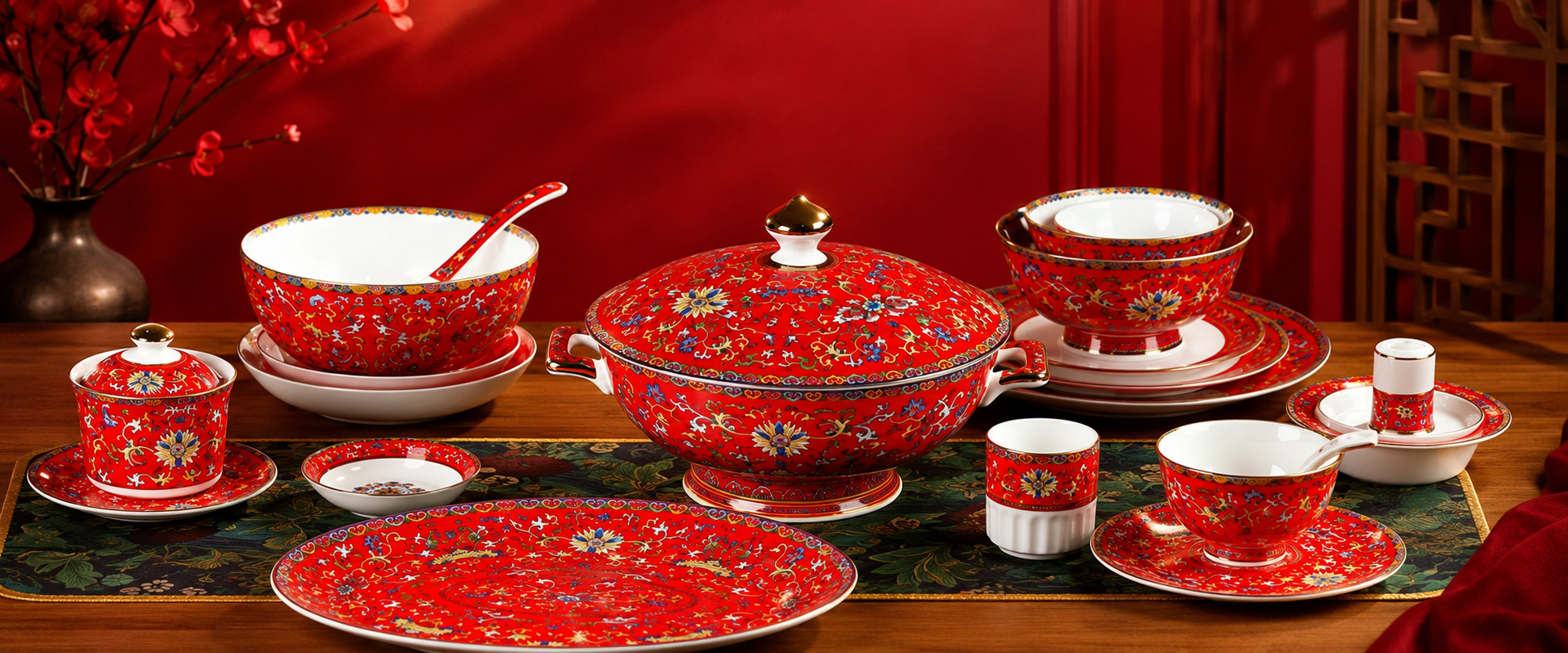
Quick answer: Ceramic tableware sold in 2026 must satisfy two layers of rules — a material rule (lead and cadmium must not migrate into food beyond set limits) and a documentation rule (you must be able to show a test report naming the exact item, glaze and firing batch). The four regimes that matter most for international buyers are FDA (US), LFGB §30 (Germany, widely used as a de-facto European benchmark), California Proposition 65 (US state, stricter warning triggers), and EU 1935/2004 with its ceramic-specific migration limits. Order the test report before you order the production run.
In this article
- Why compliance is a 2026 buying decision, not a paperwork detail
- The actual lead and cadmium migration limits by market
- FDA: what U.S. importers must hold
- LFGB and BfR XXXVI: the European benchmark buyers default to
- California Proposition 65: the exposure-warning trap
- EU 1935/2004 and Directive 2005/31/EC: the declaration of compliance
- The document pack to request from your ceramic factory
- Glaze chemistry: where lead and cadmium actually come from
- What compliance adds to your landed cost
- Frequently asked questions
Why compliance is a 2026 buying decision, not a paperwork detail
Ceramic tableware sits in an unusual regulatory position. It is a food contact material, it is fired at temperatures that can lock metals into a glass matrix, and it is sold as a decorated, gilded, sometimes food-facing consumer object. That combination means the risk is not the ceramic body itself — it is the glaze and the on-glaze decoration.
For a buyer, the practical consequence is this: two factories can both claim "lead-free" and both be telling the truth about the raw material, while one still fails a migration test because of how the decoration was applied and fired. Compliance is therefore not a certificate you collect once. It is a property of a specific item + glaze + decoration + firing curve.
In 2026 three pressures have pushed this from a formality into a live sourcing question:
- Marketplace enforcement. Amazon, Walmart Marketplace and TikTok Shop increasingly require food-contact documentation as a listing gate. A missing report now blocks sales, not just invites a warning letter.
- Private label liability shift. When you put your own brand on the box, the importer of record is you. The factory's generic report covering a different shape does not transfer to your item.
- Testing cost asymmetry. A migration test costs a small fraction of a container. Retesting or recalling after the goods land costs orders of magnitude more. The economics are one-sided.
The actual lead and cadmium migration limits by market
Most public summaries of ceramic regulation are vague ("must be safe"). Buyers need the numbers, because the numbers drive the test protocol and the pass/fail decision. The table below consolidates the limits that appear in the four regimes discussed in this article.
| Market / regime | Lead (Pb) limit | Cadmium (Cd) limit | Test method |
|---|---|---|---|
| U.S. FDA (CPG 7117.07) | Flatware 3.0 ppm; small hollowware 2.0 ppm; large hollowware 1.0 ppm; cups/mugs 0.5 ppm; pitchers 0.5 ppm | Flatware 0.5 ppm; small hollowware 0.5 ppm; large hollowware 0.25 ppm; cups/mugs 0.25 ppm; pitchers 0.25 ppm | ASTM C738; 24 h at 22 ± 2 °C, 4% acetic acid |
| Germany LFGB §30 / BfR XXXVI | Typically 0.5 mg/L for flat and hollow items (category-dependent) | Typically 0.10 mg/L for flat and hollow items | DIN EN 1388-1 / -2 |
| EU (post-2005/31/EC harmonised) | 0.8 mg/dm² (flat); 4.0 mg/L (hollow, shallow); 1.5 mg/L (hollow, deep); 0.5 mg/L (cups/mugs) | 0.07 mg/dm² (flat); 0.30 mg/L (hollow, shallow); 0.10 mg/L (hollow, deep); 0.25 mg/L (cups/mugs) | EN 1388-1 / -2 |
| California Prop 65 | No fixed numerical pass/fail; NSRL-based exposure assessment | No fixed numerical pass/fail; NSRL-based exposure assessment | Exposure modelling from migration data |
Two things are worth reading carefully in that table. First, the EU limits are differentiated by item geometry — a deep bowl and a flat plate are not judged against the same number. Second, Proposition 65 is not a limit at all; it is a warning statute keyed to a No Significant Risk Level. That difference is the single most common source of confusion for buyers sourcing from Asia for the U.S. market.
FDA: what U.S. importers must hold
The FDA does not pre-approve ceramic tableware. There is no certificate you file and no approval you wait for. Instead, ceramicware is subject to post-market surveillance and import screening under Compliance Program Guidance Manual 7117.07, with detentions driven by lead and cadmium leach testing on samples drawn at the port.
What this means in practice is that the burden is on you, the importer, to hold evidence before the shipment is selected. A defensible position consists of:
- A migration test report from a recognised third-party laboratory, referencing ASTM C738, with results below the applicable category limit.
- A statement that identifies the specific item tested — shape, size, decoration, glaze — not a family name.
- Batch traceability linking the tested pieces to the production run in the container.
- A corrective action plan describing what happens if a future batch tests differently.
The most common failure mode is not a bad product. It is a test report that does not name the item in the container. FDA investigators and customs brokers both look for the link between the report and the goods. If the report says "ceramic mug" and the box says a specific SKU with 24K gold trim, the link is broken — and the report stops being evidence.
LFGB and BfR XXXVI: the European benchmark buyers default to
LFGB is the German national food and feed code. Its §30 sets the general prohibition on harmful migration, and the practical numbers come from BfR Recommendation XXXVI, which covers ceramics, glass, enamel and glass-ceramic articles intended for food contact. The test standard is DIN EN 1388.
Why do buyers outside Germany so often ask for LFGB rather than a market-specific equivalent? Because it is specific, numerical, and widely accepted. German regulatory limits are generally at least as strict as the harmonised EU limits, so a passing LFGB report is usually persuasive evidence across Europe, and it is routinely accepted by U.S. and U.K. retail buyers as a reference point.
| Question to ask your factory | Why it matters |
|---|---|
| Which BfR section applies to this item? | XXXVI covers ceramics; a report citing the wrong section is not evidence for a ceramic item. |
| Were the samples taken from a production run or a handmade lab piece? | Lab-made samples can pass while production pieces fail if the firing curve differs. |
| Which decoration stage was tested — under-glaze, in-glaze or on-glaze? | On-glaze gold and enamel sit closest to food and carry the highest migration risk. |
| What is the test date and the report validity window? | Retail programmes commonly expect a report within the last 12 months. |
California Proposition 65: the exposure-warning trap
Proposition 65 requires businesses to give a clear and reasonable warning before knowingly exposing anyone in California to a listed chemical above the applicable threshold. Lead and cadmium are both listed. The thresholds are expressed as No Significant Risk Levels (NSRL) for carcinogens and Maximum Allowable Dose Levels (MADL) for reproductive toxicants.
The trap for importers is that Prop 65 has no fixed table of ceramic migration limits. A product can be below every FDA limit and still trigger a warning obligation if exposure modelling for the specific use case — a soup bowl used daily, versus a decorative platter used twice a year — produces an estimated dose above the MADL.
Three practical consequences:
- Use case changes the answer. The same glaze on a decorative vase and on a soup bowl is not the same proposition. Have exposure assessed against realistic daily use, not a nominal one.
- Warnings must be conspicuous. A Prop 65 warning buried on page four of a manual does not meet the standard. If you must warn, plan the label into your artwork from the start.
- Retailers may refuse regardless. Several large U.S. retailers treat any Prop 65 exposure finding as a de-listing trigger, even where a warning would be legally sufficient. Ask your buyer which they prefer before production.
EU 1935/2004 and Directive 2005/31/EC: the declaration of compliance
In the European Union, food contact materials are governed by Regulation (EC) No 1935/2004, which establishes that materials must not transfer constituents to food in quantities that could endanger health, change composition unacceptably, or deteriorate organoleptic properties. Ceramics are one of the material groups for which specific measures apply.
The operational document in the EU is the Declaration of Compliance (DoC). For ceramic articles this declaration carries a specific requirement that catches many first-time exporters: the declaration must be accompanied by a written statement of the manufacturer or importer that the article meets the migration limits, and it must be supported by test results.
| EU document | What it is | Who produces it |
|---|---|---|
| Declaration of Compliance (DoC) | Formal statement that the article complies with 1935/2004 and applicable specific measures | Manufacturer or EU importer |
| Migration test report | EN 1388-1/-2 results for the specific item | Accredited laboratory |
| Statement of compliance — ceramic specificity | Written confirmation the article is below lead and cadmium migration limits | Manufacturer or importer |
| Material and article specification | Glaze type, decoration stage, firing temperature, food-contact area | Manufacturer |
The document pack to request from your ceramic factory
This is the checklist we hand to buyers who ask us what a complete submission looks like. It is deliberately item-level. Every document in it should name the article you are actually importing.
| # | Document | Must contain |
|---|---|---|
| 1 | Third-party migration test report | Item description, photos, glaze type, decoration stage, ASTM C738 or EN 1388 method, numeric results, lab accreditation mark |
| 2 | Declaration of Compliance (if EU-bound) | Regulation reference, item identification, signature, date, statement on ceramic migration limits |
| 3 | Glaze material declaration | Lead-free / cadmium-free confirmation from the glaze supplier, not only from the factory |
| 4 | Firing specification | Peak temperature and soak time for body, glaze and decoration firings |
| 5 | Batch traceability record | Production date, kiln batch, link between tested pieces and shipped goods |
| 6 | In-house QC record | Per-batch visual and dimensional inspection, plus the factory's own leach screening if performed |
| 7 | Prop 65 statement (US-bound) | Either a no-exposure rationale or the agreed warning text and artwork placement |
If a factory cannot produce items 3, 4 and 5, treat the test report as unverifiable. Those three documents are what turn a laboratory result into a claim about your goods. Many suppliers can supply a report; far fewer can show the underlying firing specification and kiln batch linkage.
Glaze chemistry: where lead and cadmium actually come from
Understanding the mechanism helps you ask better questions and evaluate the answers you get.
Lead
Historically, lead oxide was used in glazes because it lowers the melting point, improves gloss and brightens certain colours. In modern tableware production, leaded glaze should not appear at all. Where lead still shows up in a failed test, the usual causes are: an inherited glaze recipe at a sub-tier supplier, contamination in a shared ball mill, or a low-temperature decorative overglaze intended for decorative-only ware that was mistakenly applied to a food-contact piece.
Cadmium
Cadmium appears mainly as a pigment component — bright reds, oranges and some yellows. It is the reason a red decorated plate and a plain white plate from the same factory can test very differently. Cadmium-based pigments in the body glaze are avoidable; cadmium in an on-glaze decoration is a deliberate material choice and should be disclosed.
Decoration stage matters more than the body
There are three places decoration can sit relative to the glaze, and they carry very different risk profiles:
- Under-glaze: decoration applied to the bisque, then covered by glaze and fired. The glass layer separates it from food. Lowest migration risk.
- In-glaze: decoration fired into the glaze layer. Intermediate risk, and visually distinctive.
- On-glaze (over-glaze): decoration applied on top of the fired glaze, often at lower temperature. This is where 24K gold trim and many bright enamels sit. Highest risk, and the reason gold-rimmed items so often carry a "not for dishwasher or microwave" instruction.
A practical rule: if a buyer requires both gold trim and full food-contact safety across the rim, ask the factory to specify the exact food-contact zone. Many premium programmes solve this by keeping the gilded area strictly outside the food-contact surface — for example, a rim band on a plate with an unglazed or plainly glazed well.
What compliance adds to your landed cost
Compliance is a line item, and treating it as one makes the sourcing decision clearer. Typical contributions, expressed as a share of unit cost for a mid-volume order, look like this:
| Cost element | When it is incurred | Typical weight |
|---|---|---|
| Migration testing (per item, per market) | Before production or at first article | Small fixed cost per SKU; negligible per unit at volume |
| Lead-free / cadmium-free glaze upgrade | Material purchase | Low single-digit percentage of unit cost |
| Decoration redesign to move gold off the food-contact zone | Tooling and artwork | Design cost, not a per-unit cost |
| Additional QC screening per batch | Every production run | Small recurring per-batch cost |
| Prop 65 labelling artwork | Packaging | One-off design change |
| Cost of a failed shipment (detention, recall, re-ship) | Only if compliance fails | Orders of magnitude above all of the above |
The asymmetry is the whole argument. Every line above except the last is small and predictable. The last line is large and unpredictable, and it is the one that compliance spending is buying insurance against.
Frequently asked questions
Is "lead-free" the same as "passes FDA"?
No. "Lead-free" is a statement about material composition. FDA compliance is a statement about migration under a defined test. A piece can be made without any intentionally added lead and still fail if contamination occurs, or if a cadmium-bearing decoration is used. Always ask for the migration report, not just the material claim.
How long is a ceramic migration test report valid?
There is no universal expiry. Retail programmes commonly ask for a report issued within the last 12 months, and many require a fresh report whenever the glaze, decoration or firing specification changes. If any of those three changes, the previous report describes a different product.
Do I need separate reports for each colourway?
You need a report for each combination that differs in a way that affects migration. A colour change that swaps a pigment is a material change and normally needs its own test. A size change to the same shape and glaze usually does not, though some buyers still require it.
Does gold trim automatically fail?
No, but it raises the risk and narrows the usable claims. Gold decoration is typically applied on-glaze, which places it on the food-facing side of the glaze rather than under it. The workable approach is to test the finished item and, where needed, restrict use instructions or reposition the gilded area outside the food-contact zone.
What is the difference between LFGB and EU 1935/2004?
LFGB is German national law with specific numerical limits and a specific test standard (DIN EN 1388). EU 1935/2004 is the European framework regulation, supported by the Declaration of Compliance mechanism and harmonised ceramic limits. A German LFGB report is frequently accepted as evidence in other EU markets, which is why it is so commonly requested.
Can a supplier use one report to cover a whole product family?
Only where the items are genuinely equivalent in body, glaze, decoration and firing. A family report that spans different shapes, different decoration stages and different glaze systems is not defensible. The test report should identify the article specifically enough that a third party could match it to the goods.
Need a compliance document pack for a specific item?
We prepare item-level migration test documentation, glaze declarations and firing specifications for bone china and ceramic tableware programmes bound for the U.S., EU and U.K. Tell us the item and the destination market, and we will come back with the document list and the testing route.
Related reading
How lead safety and food-contact rules apply specifically to glazed bone china, and what to check on the factory floor.
Sources: U.S. FDA Compliance Program Guidance Manual 7117.07 (imported ceramicware), German LFGB §30 / BfR Recommendation XXXVI, EU Regulation (EC) No 1935/2004 and Directive 2005/31/EC, California Proposition 65 (Safe Drinking Water and Toxic Enforcement Act of 1986), ISO 6486-1/-2.
Related articles in this series
- Sustainable Ceramic Tableware Manufacturing: Glaze, Energy and Packaging in 2026
- Ceramic Tableware Lead Times in 2026: A Buyer's Supply Chain Timeline
- Bone China Market Trends 2026: What Retail and Hospitality Buyers Want
- Decoration Trends in Ceramic Tableware 2026: Gold Trim, Enamel and Cultural Patterns
More sourcing and market analysis for ceramic tableware buyers is published in our Industry News collection.